
Published · 5 min read
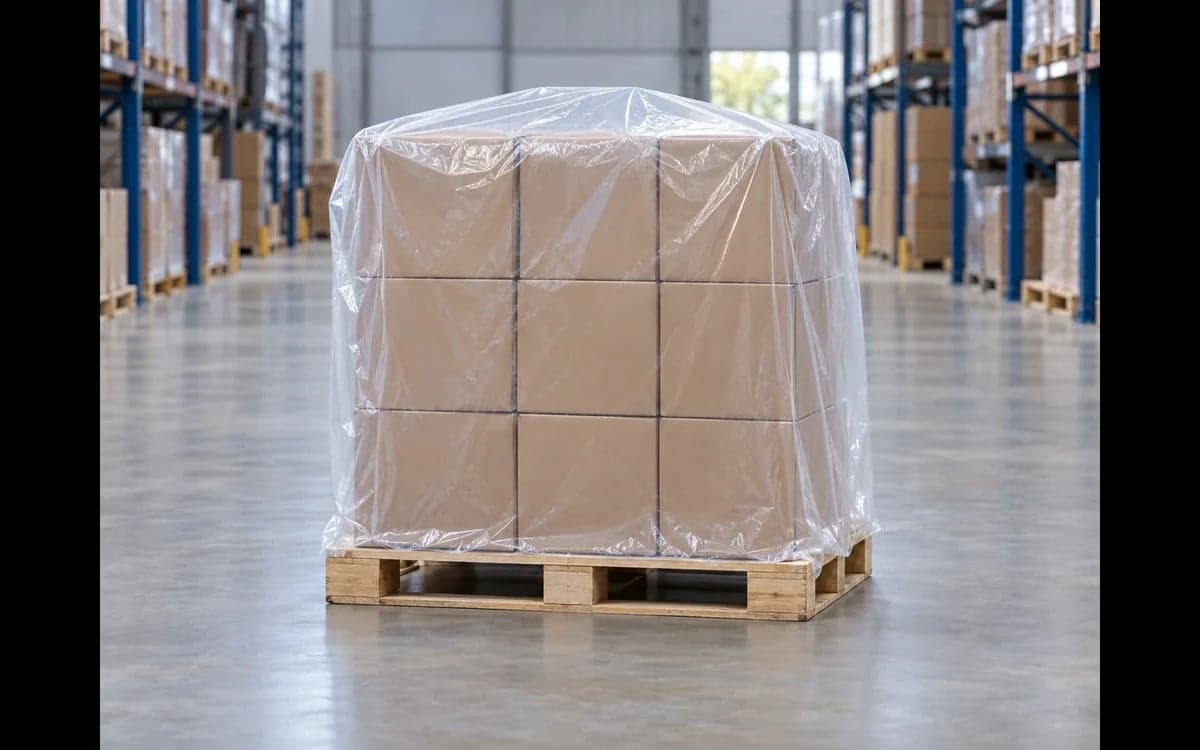
Pallet cover size should not be selected from the pallet footprint alone. The object that matters is the widest and tallest outline of the finished unit load. A correctly sized gusseted cover follows the corners, drops without excessive force and leaves enough skirt for the intended closure.
Confirm the bag style before measuring
A common pallet cover is a large side-gusseted PE bag with one closed end. Its order dimensions are normally stated as width × depth or gusset × length. A flat, non-gusseted bag is described by layflat width and length instead. These formats are not interchangeable, so the drawing must identify the open mouth, closed end and meaning of each dimension.
Measure a real load in its shipping condition rather than an empty pallet. Include corner boards, top sheets, projecting cartons and the outer stretch-wrap profile. If several stacking patterns are used, record the maximum dimensions of each and identify the largest practical configuration.
Starting calculation for a gusseted cover
Call the long side of the load A, the short side B, and the overall height from the base H. Industry measuring guides use this practical starting relationship:
Cover width: A plus fitting clearance
Cover depth: B plus fitting clearance
Cover length: H plus B/2 plus any bottom closure allowance
Half of B is added because the closed top consumes material while travelling from the top centre toward the side. Clearance and closure allowance are not universal constants. Load regularity, film stiffness, gauge, manual or automated application, and the closing method all affect them. The calculation therefore defines a sample size, not a substitute for a fit trial.
Worked example: 1200 × 1000 × 1450 mm
Assume the measured load is 1200 mm long, 1000 mm deep and 1450 mm high. Width and depth are specified slightly larger than the actual outline to provide the chosen clearance. The geometric starting length is 1450 + 500 = 1950 mm. Add a separate allowance if the skirt must be tucked under the pallet, taped or heat sealed. If cartons project to 1240 mm, use 1240 mm rather than the nominal 1200 mm pallet size.
When a flat bag is used
A flat bag must provide enough layflat width for half the rectangular load perimeter. The geometric minimum is A + B, before fitting clearance. A 1200 × 1000 mm load therefore starts at 2200 mm layflat width. Thick film pulled over hard corners, an irregular stack and manual handling may require additional room. Too little width concentrates stress at the corners; too much leaves loose folds that interfere with closure and appearance.
Five common measuring errors
1. Using the nominal pallet footprint
Cartons, sacks or components can overhang the deck. Measure all four faces at their widest points and record asymmetric projections.
2. Measuring height from the wrong datum
If the cover must enclose the complete unit, measure H from the pallet base. A cover intended only for the product may use a different datum. State the choice on the specification.
3. Forgetting the closed-top consumption
The closed end does not remain as a flat lid without using length. Approximately half the short side is needed to travel over the top geometry. Omitting it creates a skirt shorter than expected.
4. Assuming every load is identical
Bulging sacks, mixed carton patterns and variable top boards alter the envelope. Measure minimum, typical and maximum loads, then decide whether one cover can serve the range without excessive looseness.
5. Choosing closure after the cover
A loose skirt, tape closure, heat seal and under-pallet tuck need different allowances. Define the closure, mouth orientation and seal position before finalising length.
Do not confuse dimensions with film performance
Dimensions determine fit; material structure affects puncture, tear and handling behaviour. Extra gauge does not correct a cover that is too tight. If sharp corners are present, first examine corner protection, load arrangement and contact points, then select film using trials that represent actual handling. Outdoor exposure, storage duration, opacity, UV requirements and direct product contact must be stated separately rather than assumed from the word “cover.”
Poşetsan Date evaluates load geometry, application method and closure allowance together when developing pallet protection film. When discussing a sample with Poşetsan, provide A, B and H, the maximum overhang, photographs and the closing method. Explore Date Plastik information on pallet protection, related PE bags and sacks, and PE bag production.
Pre-order sample checklist
Build the load exactly as shipped and measure all axes at the widest points.
Mark width, depth, length, open mouth and closed end on the cover drawing.
Fit the sample using the normal operator and application method.
Check corner tension, empty space at the top and skirt reach on every face.
Close the cover and observe it during representative handling, stacking and storage.
Add the approved dimensions, film description, drawing and fitted photographs to the purchasing specification. This turns the vague instruction “fits our pallet” into a repeatable reference for production and incoming inspection.